Monday, 2 July 2012

Kauai five-oh

It's only just turned July and already I remember I'm not built for winter, and neither is the house I live in (no matter how many door-snakes I put around the place). So I could hardly pass up the chance to go to Hawaii a couple of weeks ago. Spent most of my time there on Kauai which, to my eyes, is the most beautiful of the main Hawaiian islands.

Hula-girl in wintry Sydney
If ever you wanted to invent the perfect island, you could do worse than use Kauai as your blueprint. Aside from the perfect beaches, there are lushly forested mountains, waterfalls, hiking tracks, the massive Waimea Canyon. It oozes "lost worldness".

Which brings me to the doorstep of my top five things to do on Kauai:

Just keep the cliffs on your left
1. Paddle the Na Pali coast – this 27-kilometre paddle along the roadless north-west coast of Kauai is billed as the Everest of sea kayaking trips. Not having climbed Everest I suspect that's a slight exaggeration, but Kayak Kauai (which has been running these trips for more than 20 years) says it is the longest and roughest commercial sea kayak trip "on the planet". That's the fun of it; you're out there, in the elements, all day, just you and the turtles. Your guides carry things like EPIRBs and flares. And the scenery - those 1000-metre cliffs, crescent-moon beaches, sea caves you can paddle into - will blow your hat off.

2. See Jurassic Park Falls. First, a confession: this one ain't no-impact. But it's hard to say no to a helicopter flight that takes you to one of the world's most spectacular waterfalls. Our Island Helicopters pilot Gary, with his smooth-as-caramel voice and an iPod soundtrack to match the views (Mission Impossible, Born to be Wild), flew us all over the island but the highlight was speeding along a canyon towards Jurassic Park Falls (aka Manawaiopuna Falls), the movie theme playing in our headsets. We landed at the base of the falls too, the only people there (it's on private property); I felt like Laura Dern about to see my first living dinosaur.


Janet waxing up
3. Go surfing. On one of my five days on the island I rented a surfboard and caught up with my friend Janet who has moved to Kauai from New York (we both lived and surfed in Japan about 100 years ago). Surfing is the best "in" to island life, because, well, everyone surfs. We met so many people that day; even up at Waimea Canyon, sightseeing on our way back from the beach, we got talking to a guy who, on hearing my accent, started reminiscing about the Australian surfers who “busted down the door” of the North Shore surfing scene in the 1970s. 

Palm trees at sunset, Koa Kea
4. Stay at Koa Kea Resort. I don't usually love resorts; I get bored after five minutes of reading by a hotel pool (though I can read for hours almost anywhere else, go figure). But I loved Koa Kea. Beautiful coral-themed décor, friendly staff (the valets were surfers too) and a superb waterfront location at Poipu on Kauai’s south coast – I swam off the beach every morning and even surfed right in front of the resort one afternoon.

5. Watch the sunset at Hanalei Bay. The day I arrived was Memorial Day, the American equivalent of our Anzac Day and EVERYONE was at the beach. I caught up with friends who live on Kauai’s north shore and we drove to the pier at Hanalei to watch the sunset. There were cars parked on the sand, people paddleboarding with their dogs, girls hula-dancing in the shallows while their fathers and uncles played drums on the shore, a guy strumming a ukulele. Behind the curve of beach, ruggedly handsome mountains stood with their heads in the clouds. If I lived here I’d believe in Puff the Magic Dragon too.

That’s my Kauai-five, but oh, there’s one more Hawaii must-do: have a ukulele lesson, listen to ukulele-playing kids busking (click for a little video clip) on Kalakaua Avenue in Waikiki or, at the very least, listen to the song that has become Hawaii’s unofficial anthem: "Somewhere over the rainbow" (another clip) by Israel Kamakawiwo'ole. Humming along is a good way to keep warm...

Hands up who's been to Hawaii? What did you love?

Monday, 21 May 2012

Wild kingdom: Sydney Harbour

Today's blog post is sponsored by marine creatures great and smaller that frequent the Sydney region: whales, penguins, dolphins and sea lions. Wait a minute..."Sea lions"? A couple of days ago, I wouldn't have thought to include this pinniped (my word of the day) but now I know better.

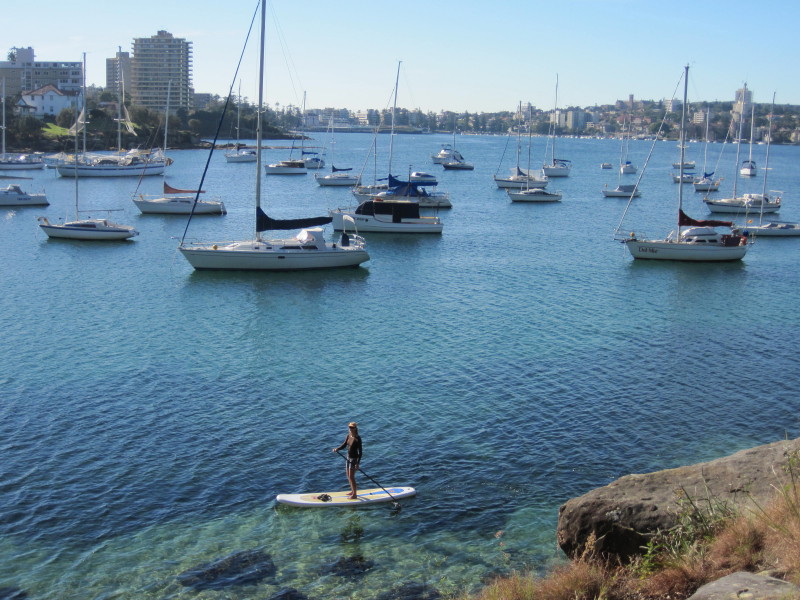
On Saturday, while stand-up paddleboarding in Sydney Harbour, I saw a sea lion, sunning itself on a marina right across the water from where I live. I’ve never seen one here, never even heard of them coming into the harbour and at first I thought it was a dog. 

I did a double-take and sure enough, there was the thick neck, the pointed nose, the lithe figure as it slinked into the water and was gone...Could it be an endangered Australian sea lion, usually found in south-western Australia? I paddled on, and glancing back saw that it had returned to its sun-spot between the boats. It just goes to show: you don’t have to live on Macquarie Island to have a sea lion in your backyard.

Sydney sea lion (thanks, Craig)
Then this morning, just as I was sitting down to work, I got a text message from my dad: “Whales out your window”. He lives up the hill from me, and we share a view of the harbour which, today, included a cluster of boats, including a tall ship and the Manly Ferry, loitering between North and South Head to ogle a couple of humpbacks at the entrance to Sydney Harbour on their way north from Antarctica to Queensland. 

The lovely Kaiser
My feline friend Kaiser died last year - I know, it's not very no-impact of me to have had a cat but in his defence, he wore two bells and in his twilight years was as mellow as a monk (i.e. not a hunter of native birds and mammals). I still miss his gentle soul, but lately I’ve been noticing how many wild animals we share this big city with:

Seagulls snoozing with their heads tucked under their downy wings on the beach. Pelicans soaring in formation high in the blue sky. Carpets of sulphur-crested cockatoos feeding on a cache of seeds. Stingrays on the sandy sea floor, below my surfboard. Sharks - I saw five (small ones) while swimming between Manly and Shelley Beach. A brush-tailed possum (below) that came aknocking one night last week, probably tempted by the little berry-like wreath that decorates our back door. 

And here's a brief clip of some dolphins we saw in North Harbour (shot by Craig, again from his paddleboard, last week). 

While we're on the subject of animate things, let's not forget the insect world. I had ants in my laptop a few weeks ago. Some vigorous drumming on the keyboard (when I wasn't even on deadline) shook them loose. And what about plants? And why not non-living natural things: rocks, the sea, the ground itself...

We need them all, to remind us what's important - that, whether we're aware of it or not, we are all part of the natural world, sea lions included.


Tuesday, 8 May 2012

The yellow brick garage-sale road

Last weekend I spent the sunniest part of a whole day in my own backyard - and it was one of the most enjoyable Saturdays I've spent in a while.

I met a whole bunch of friendly neighbours I'd never seen before. Talked about waves with a couple who bought one of my surfboards and a copy of my book Surf's Up: The Girl's Guide to Surfing (pardon the plug). Chatted with neighbours I do know, who popped in to say hello. Gave away brownies I'd baked the night before. Got rid of some pretty good stuff that other people wanted more than I do. Oh, and I made a few bucks in the process.

All thanks to the Garage Sale Trail - a Bondi-based initiative started in 2010 in the name of "sustainability, community and creativity" to encourage people to offload things that might otherwise go to landfill. That first year, there were 130 garage sales across Sydney. Last weekend, there were 6000 garage sales across Australia - pretty cool, huh? You can register your sale (and give it a name, like The Man Sale or Brownies in the Backyard) and people find you online or on their phones as they wander around your suburb.

I don't think I've ever spent a whole day in my own backyard. An afternoon, sure. A morning having breakfast and reading the paper in the sun, certainly. This was different. I liked the commitment of it. Stay. Go nowhere. Be here for whomever walks in through the gate. Greet them with a brownie (my favourite part).

There's something to be said for sticking with one thing, one place, particularly at a time when it's easy to feel paralysed by choice. Next weekend I might try staying somewhere else all day, switching off my phone and just being, well, there.

Psst! Want to buy a windsurfer? Two sails, harness, new mast-step, going cheap...


Thursday, 26 April 2012

River red gum time


“I speak for the trees, for the trees have no tongues…” The Lorax was too late to save the truffula trees in Dr Seuss's famous story (well, except for - spoiler alert! - that one lonely seed the Onceler gives the boy at the end, with the words, "Plant a new truffula. Treat it with care. Give it clean water. And feed it fresh air.") 

Beautiful, aren't they?
The river red gum forests of southern NSW looked like going the same way, having been logged since the 1820s - until July 2010, when the state government protected them in a 107,000-hectare swathe of national parks, nature reserves and regional parks. It was a good month for trees.

Last weekend I camped in one of these newly protected forests, Murrumbidgee Valley National Park. 

It was like going back to a freer, simpler time. My friends and I had to get a mud-map from the local tourist office to find our bush campsite, at the end of a muddy maze of dirt roads and on the banks of the Murrumbidgee River. There was no park entry fee, no camping fee. And when we got there, there was no one but us. 

Kayak on the Murrumbidgee
We spent two whole days in, on and next to the river, and always surrounded by red gums. On Saturday we kayaked for half a day, with a new tour operator called Riverina Experience, past fallen trees, high eroded banks and tangles of exposed roots, evidence of the floods a couple of weeks ago when two metres of rain fell in one drenching, 24-hour period. 

My, what big claws you have
From our kayaks, we saw FIVE koalas, in the high branches of the river red gums overhead. It's only the third time in my entire life (so far) I've seen koalas in the wild. Some of them were even active, climbing branches, looking down on us, listening to us with their teddy-like ears (does that count as anthropomorphising?). 

Bikes in the bush
On Sunday we rode mountain bikes, also with Riverina Experience, along the river and through Narrandera Common (officially called Narrandera Flora and Fauna Reserve), through open woodland. 

As our guide Ian Hardie explained, this is what the original, pre-logged red gum forests looked like: big, gnarled trees with spreading branches and lots of open space between them. (Our campsite, by contrast, had lots of skinny red gums close together, due to decades of management by forestry). 

Our river red gum campsite
We swam in the river. We camped by the river, listening to its gentle gurgle as we fell asleep in our tents (spacious Lansan Plus tents with massive vestibules, kindly supplied by – sponsor alert! – Kathmandu). We even met a Wiradjuri man, Michael Lyons, who showed us how he makes didgeridoos and boomerangs from local woods, offered us witchety grubs and took us to see an "Aboriginal hotel" - a hollowed-out red gum big enough for a family to sleep in. 

One of the most back-in-time aspects of the trip was our campfire. It was a real fire, made from gathered logs and sticks (not pre-chopped wood). Which (naturally) made me look into the environmental impacts of campfires. On the minus side: there's all that carbon dioxide going into the air, and faster than if the dead trees were left to decompose. 

On the plus side: it was one campfire used for three days, by seven people, for cooking, warmth and light (the days being cooler and shorter now) and we didn't have to throw away any butane canisters (from a fuel stove) after the trip. 

Wood is also more renewable than gas. Trees can be replanted; once gas (or any fossil fuel) is out of the ground, there's no giving the carbon back. Also, apparently fires that burn with intense heat and minimal smoke aren't so bad. I wouldn't want to have a campfire every night, but there was something wholesome about having one for this trip. (Read more about the environmental effects of burning wood here.)

Want to see river red gums? You can drive to Narrandera in under five hours from Sydney or Melbourne. Fly with Rex and you'll be there in an hour (we did the latter, and I offset my flights with Climate Friendly, as always). 


Thursday, 12 April 2012

Christmas (Island) in April

Think of Christmas Island, a remarkably terrier-shaped island in the Indian Ocean, and chances are four words will spring to mind: "migrating crabs" and "detention centre", not necessarily in that order.

One in 50 million, a red crab
David Attenborough put the island on the nature tourism map back in the 1980s, by declaring the annual migration of more than 50 million red crabs from the jungled centre of the island to its pristine beaches to be one of the most spectacular sights on Earth.

It's also been called called the "Galapagos of the Indian Ocean" for all its nesting seabirds and other wild things. Then along came the Australian Government, building a detention centre in 2005 to "process" asylum seekers arriving in Australian waters.

It'd be easy to not like the island on principle - until you go there. Here are
10 good reasons to like, even love, Christmas Island (which was named on Christmas Day, 1643, by British explorers - in case you were wondering) based on my trip there last week:

1. Its natural beauty. The first thing you notice, after flying for almost four hours over the Indian Ocean (CI is only 360km south of Java but 2600km from Perth) is the royal-blue sea ringing the island, then the narrow coral reef, the rugged limestone coastal cliffs, and the green, green forest - 64% of the island is national park.
Greta Beach sunset
2. It's not an “island paradise” (which, let's face it, are a dime a dozen these days). That means two things: the locals don't have that "I live in paradise and I know it" attitude, and there are real beaches, not just limpid lagoons. Sparkling water, a few waves to play in, squeaky white sand, marine creatures galore - what more could you want? 

3. The snorkelling/diving. Lots of places claim to have great snorkelling. Christmas Island's marine environment is the real deal: on one snorkelling excursion, the visibility was 30 metres and we swam beside a drop-off like an undersea cliff that disappeared kilometres into the blue. It's not uncommon to see dolphins, turtles, even whale sharks - our dive boat skipper saw 250! two summers ago - just 20 metres from shore.

Pic by Shawn Brenneman
4. It's untouristy, for now. The only other tourists my friends and I saw were two detention centre workers having a day off to dive and do a bird tour. The main street is, if I may be blunt, ugly - but that's part of its charm. It's a working port, not a tourist trap. And anyway, the island has so many natural attractions, it doesn't need man-made ones.

5. It's safe as a country town. You get used to not locking your car or hotel room, and leaving your camera on a cafe table while you go inside to order (and yes, you can get real coffee here).

6. You can go to the movies for $5 ($2 for kids) - at the weekly outdoor cinema, with a different film shown every Saturday night. I LOVE outdoor movies and that's gotta be the cheapest movie ticket in Australia.

7. It's tropically warm day and night. The water is 28C, all year round. Sure, the humidity can get a bit much in the jungle, but you don't have to go far to throw yourself (safely) into the sea to cool off.

Brown booby sea-watching
8. The great outdoors. I spent five days there and the only time I went indoors was to sleep (at The Sunset, a quiet seaside lodge with a wide verandah). We snorkelled and swam in Flying Fish Cove, explored a cave by the light of our head-torches, bird-watched for nesting frigate birds, brown boobies and rare Abbott's boobies. One afternoon we walked in the Dales, where freshwater wends its way through an enchanted forest reminiscent of Rivendel in The Lord of the Rings (minus the elves); then we had a sunset picnic at Martin Point, on the west-facing side of the island. 

Pic by the lovely Carla Grossetti
Best of all, I got to celebrate Earth Hour on this remote rock in the Indian Ocean (it's actually the top of an ancient volcano). My friends and I took beeswax candles to The Grotto - a seaside cave where we swam, by candlelight, in a sparkling, partly spring-fed pool, then sipped champagne to honour the occasion. It's my favourite Earth Hour yet.


9. You can go trawling for goshawks. What the? Biologist Mark Holdsworth invented the method, to tag endangered Christmas Island goshawks (here's one he tagged earlier, at left). He uses the arm of a toy gorilla as a lure at the end of a fishing line, and we took turns riding with him in the back of his ute as we drove along a bush track. Strange but true. 

10. The crabs. It always comes back to the crabs on Christmas Island. We weren't there at migration-time (that's at the start of the wet season, usually October or November) but we saw plenty: giant robber crabs (called coconut crabs on Pacific islands) eating mangoes, blue crabs hiding amidst tree roots; sometimes we'd have to walk in front of our rented 4WD to shoo crabs away from the tyres. CI sure is an interesting and amazing place. Fifty million red crabs can't be wrong...

PS What did you do for Earth Hour this year?