Tuesday, 22 October 2013

I won, I won! (said with glee not gloating)

This is me on the inside at the moment: running full pelt along an empty beach, cartwheeling occasionally, splashing through the shallows, barefoot of course. If I could bark, I would be yelping at seagulls. If I had wings, I would run at the wind and take flight. 

Zen and the sea - the beautiful
Hyakuna Garan in Okinawa, Japan
It's partly due to the fact that I spent all of last week playing in the outdoors on Lord Howe Island (again? Stay tuned for a new post on why I went back so soon to my favourite little island on Earth). 

And partly because, I'm just going to come out and say it, I won three awards at the Australian Society of Travel Writers' annual awards night on 12 October. (Yay!)

(My writer friend Rob McFarland, a fellow finalist for this year's big award, emailed me from New York after the event to call me an "award-winning writing machine", which I'll take as a compliment, thanks Rarb.) 

I am utterly honoured to have won, for the fourth time, the ASTW Travel Writer of the Year award for a portfolio of my three best published stories for the year. 

Two of the stories also won individual awards: for Best Responsible Tourism Story (the story about charitable tourism in Cambodia) and Best International Story over 1000 words (Temple for the Senses, about a Zen-inspired luxury hotel in Okinawa). 

Not the cat that swallowed the canary,
the goanna that ate the rabbit
- on the Arkaba Walk
The third story - Leaving no footprints - was about a tourism-funded conservation project cleverly disguised as a three-day walking trip, the Arkaba Walk in South Australia.

It's great to see travel stories about the positive side of travel getting some attention, and eco stories winning major awards (not just eco-writing ones). It's rewarding too, to be recognised by one's peers, people who know first-hand that behind the glossy exterior of our profession there are, as in any job, grindstones and both-ends-burning candles.

(I'm writing this from my latest abode, for instance, a hotel room in my hometown of Manly, but that's another blog post...)

Congratulatory hugs to all the other 2013 award winners. Larger-than-life thanks to all the award sponsors and to YHA Australia for the accommodation over the AGM/awards weekend. Now, if you'll excuse me, I have a beach to mentally gallop on...

Monday, 9 September 2013

Is this Bali's most unusual hotel?

I'm (temporarily) back in Sydney - home from Ubud, about to leave for South Africa - but before my head fills with new things, I wanted to write about the place in Bali that will linger longest for me: Michi Retreat.

Gate to "the way"
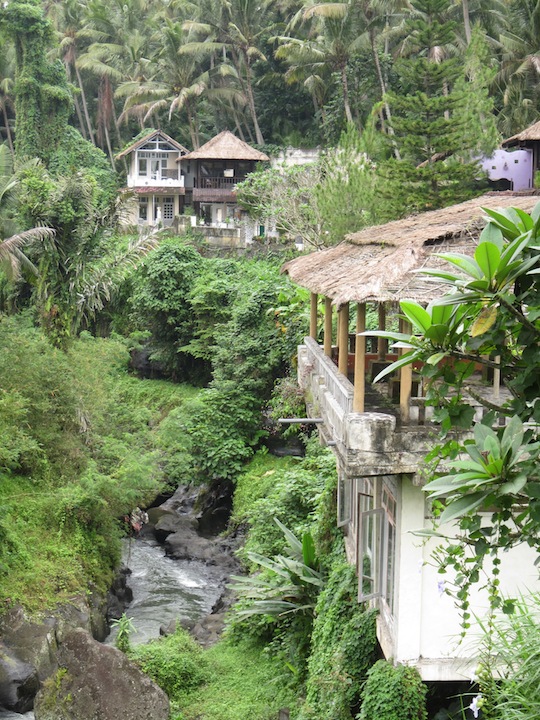
Michi's backstory, briefly: a complex of villas and rooms, it was built beside the rushing Wos river (and about 15 minutes south of Ubud by scooter) more than a decade ago as a place for creatives to gather, swap ideas, relax and make art. 

In true "retreat" style, it has a meditation pagoda over a lotus pond, a yoga studio, a spa (and salon, complete with beehive-hairdryers) and Buddhist and Hindu sculptures all over the grounds. Its name even means "the way" in Japanese.

Mermaid by the sparkling pool
These days Michi is run as a hotel (it's on Airbnb, Tripadvisor, Agoda and Wotif), albeit one that draws seekers of all persuasions and is a work of art in itself - with everything from fruit painted on walls and mermaids by the pool, to Gaudi-esque sculptures and praying-frog statues. 

It's definitely one of the most unusual places I've stayed - and one of the most well-travelled, thanks to Michi's reclusive owner, a retired professor originally from Manchuria who has lived everywhere from Kathmandu to Krakow, and now writes history books (his latest is about America in the early 20th century) in Japanese.

My Turkey room
For two weeks, I stayed in the bamboo-walled Japan-room called Hotaru, which means "firefly" in Japanese, before moving next door to Turkey (a light-filled, mosaic-mirrored room called Anadolu) for another two weeks.

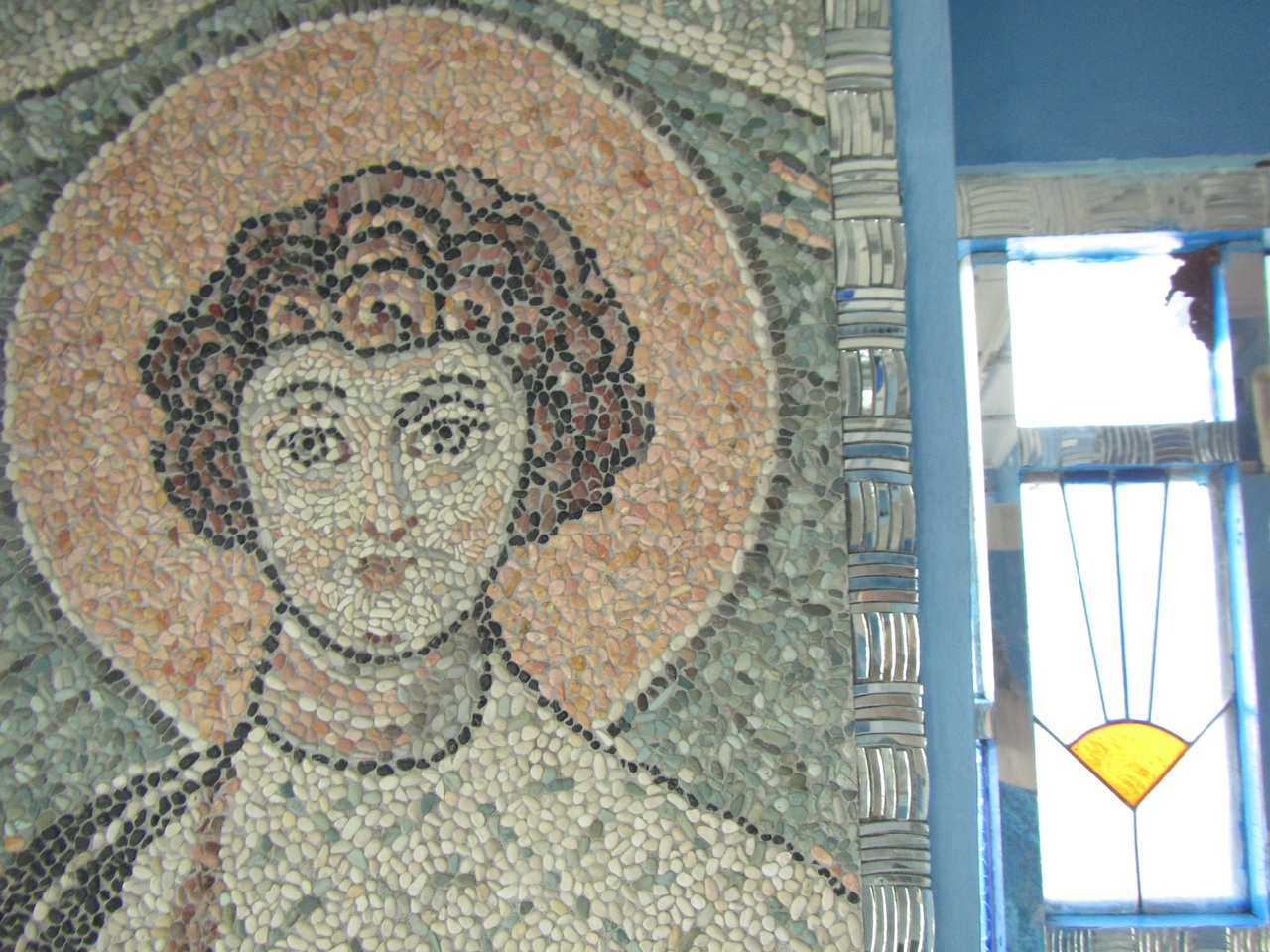
There are rooms called Mekong, Feng Shui, Only Yesterday (reminiscent of Paris in the 1920s). There's a Zen villa with shoji walls. A Rajasthani room called Merra. A blue-walled Mediterranean room with Grecian mosaics. 
Cafe Michi

One of the reasons I felt so at home at Michi was its refreshing and very un-hotel-like lack of rules. 

You won't find a compendium in your room explaining which number to call for housekeeping or what time you can have breakfast. Or any signs saying when you can use the pool. You can wander wherever you like (peeking in unoccupied rooms, their doors wide open for airing). There are no daily yoga classes or activities. 

My daily breakfast table
Michi's restaurant too is more like a common room, a place to sit at the mosaic-topped tables and read, work, chat to fellow guests about matters of the spirit, mind and body (this being Ubud) or gaze at the parallel lines of the rice fields across the river. 

And there can't be many hotels that have a resident professor. He rarely sleeps, and welcomes guests to his attic-like apartment between 9pm and 11pm any night of the week. 

The prof
The first time I visited him, his speckled sausage-dog Bubu announced my presence with a few yaps. “Come in, come in,” the professor said, ushering me to a chair among the papers and handing me a glass of palm wine infused with snake. (Other guests get grappa, or cognac.)

I listened to him, rapt, for almost three hours, as he told me stories from his unwritten memoir. About Istanbul, where he taught and stayed in a hotel a few doors up from Agatha Christie, who was writing Murder on the Orient Express at the time. About living in a hotel in Kyoto for 20 years (“Why not? Clean sheets, restaurants, two bars, no need to cook!” he said). About honeymooning with his second wife on a cargo ship as it crossed the Pacific from Japan to San Francisco. 

He's 83 this year but feels “about 60” and says he'd like to have “one last love affair” before he steps into the void. One night I saw him dining in Michi's restaurant with a 20-something Russian guest; when he came over to my table to give me a glass of Argentinian wine, ever the generous host, he whispered to me, "Her father used to work for the KGB!"

Michi's kindly staff
There are sustainable aspects to Michi too. Its setting couldn't be greener, literally. Most of Michi is made out of recycled materials. Drinking water comes from an on-site spring (I didn't buy a single plastic bottle of water in the month I was there, yay). There’s no air con, just fans and the cooling trade winds that blow along the valley. 

It's not all rainbows and lollipops. Every new guest seems to have the same double-barrelled first impression: wow, this place is incredible and boy, is it run-down. The rooms are kept clean, tidy and lovely. But the place is so detailed - every surface, indoors and out, has been painted, mosaic-ed or inlaid with stones, marble or mirrors - it needs regular upkeep, which it hasn't been getting lately.
Mosaic in the
Mediterranean room
But Michi’s star is rising, it seems, as it attracts more people who catch its spirit and want to help restore it to a new glory. There's talk of a new manager, creative work-parties to spruce the place up a bit, long-term rentals for artists. 

I loved staying at Michi - for the simplicity and sense of freedom I felt there. For the professor's presence, working in his bookish nest every day and night, inspiring me to write. For how it arouses wonder and curiosity in everyone who comes down its driveway, and reminds us of the things that matter more than material perfection.

Leaving Michi was like leaving home all over again. The professor gave me a present (a book of Tagore's poems) and the staff stood in the driveway to wave me goodbye. May it brush off the cobwebs soon and become one of Ubud's quietly shining stars. 

Sunday, 1 September 2013

On being an un-tourist in Ubud

Almost at the end of my month-long sojourn in Ubud, Bali, and I've got that end-of-summer feeling when suddenly I realise this isn't going to last forever. I've also been thinking about how different this trip is, compared to my usual way of travelling.

Tree necklaces:
Ubud is my kind of place
I can’t remember the last time I went somewhere, particularly overseas, and didn’t visit any of the local attractions. I've been here four weeks and I haven’t been to Ubud Palace or any museums or art galleries. I haven't been rafting, taken a cooking class, climbed Mt Batur at sunrise (though I did do that a few years ago). I went to Ubud market for the first time yesterday (and didn't buy a thing).

There it is again...
Much as I love Lonely Planet guides, I didn’t bring one this time. Nor did I re-read the "bible" of Ubud: Eat Pray Love (there are references to it everywhere here). I had a basic tourist map - until I lost it. I didn’t bring a phone that could Google maps for me.

This was all by design, not chance (except for the losing the map part). I wanted to travel differently, without an eye on stories I’d have to write (I might not write any stories about Bali, actually, besides these blog posts), and I really came seeking peace and time to work on a few writing projects that deadlines always kept me from starting back home.

Along for the ride, like a
gecko on a windscreen
I've been an un-tourist in Ubud, and it’s been surprisingly liberating. (Next I’ll try to stop taking a notebook and camera everywhere, but one change at a time...). 

It's been a dose of slow travel, quiet travel, even old-fashioned travel reminiscent of a time before TripAdvisor when it took much longer to reach faraway places and when you got there, you stayed a while. 

It's not so much a holiday, just life in a different place, at a different pace. I like it a lot.

I've spent whole days reading, writing and swimming at Michi Retreat, where I stayed for most of my month, the longest I've ever been resident at a hotel. I felt like a character in a Graham Greene novel, particularly at the eccentric, arty Michi, which was built as a creatives' retreat anyway.

My feet love Ubud
I rode my rented scooter to Ubud some days, through villages whose names I didn't try to find out. Had $4 foot massages that I just enjoyed. Went to yoga classes in the open-air, timber-floored studios at the very Ubudly named Radiantly Alive (in travel-writer mode I would've gone to Ubud's famous Yoga Barn too, but I wasn't, so I didn't).

Ubud graffiti-art
Sometimes whole afternoons would slink by while I hung out in organic cafes with new friends. When we got tired of talking, we eavesdropped on conversations at neighbouring tables (out of curiosity, not malice) - which was always edifying.

I'm open to most things but Ubud does wacky like nowhere else. Whatever you want, you can find it here: infrared saunas, magic-mushroom shakes, flaming hula-hoop performances, miracle coaches (a step up from life coaches). I overheard a girl saying she was going to get her hair "decontaminated" (um, what?) and every second person seemed to be on a 12-day detox. One of the nightspots here is even called Laughing Buddha.

Getting back to those cafes ... Eating well, preferably organically, is the number one pastime of un-tourists in Ubud.

From the “orange amazing healing” juice in Dayu’s Warung to the “Om omelette” at the uber-chic, shoes-off Clear Cafe, whose mantra is "Eat the food you wish to be" - Ubud's edible experiences are in a class of their own.

My favourite places here have drinking straws made of green glass or bamboo (so drinking your raw vegan tropical smoothie at Bali Buda - which is delicious, by the way - is like sipping a flute). But my top five edible Ubud experiences would have to be:
Cubby-house dining
at Warung Saya
  1. Clear Cafe's more-delicious-than-it-sounds vegan chocolate “mylk” shakes, made with coconut ice cream and locally harvested cashew nut “mylk”.
  2. The best little restaurant in Ubud, literally: Warung Saya, a cubby-house in Jalan Gautama and the toughest place in Bali to get a table because there are only two - tables, that is. Looks so pretty at night with fairy lights framing its open window that passersby stop to take photos. 
  3. The iced cappuccinos at Casa Luna, whose Australian owner Janet de Neefe runs Ubud Writers’ and Readers’ Festival every October, which began as a healing project in the wake of the first Bali bombing 10 years ago. Also Seniman "coffee studio" for its recycled-bottle glasses and designer rocking chairs.
  4. A rice fields walk that ends at Sari Organik, a two-tiered cottage in the a sea of green with volcano views, and incredible salads. You can even pick your own ingredients and they'll make them into a meal for you. 
Circus-tent with a view
5. On the way to Sari, you'll pass the relatively new Cafe Pomegranate, a cafe-in-a-circus-tent with 360-degree views of those rice fields; I love that they give you a rattan fan and a small brass bell to ring for service.

It's my last day in Ubud tomorrow and I'm not ready to leave. It's not that I haven't seen or experienced everything; I know I haven't and one more day won't change that.

It's more like leaving someone you've only just met but know you want to spend more time with. I don't just mean Ubud, it's the whole un-tourist thing. I'm not sure I can ever go back to the other way of travelling now, not completely. Part of me will always be looking for the un-tourist way, just as Ubud taught me. So we stay up talking into the wee hours, linger over coconut smoothies, swap email addresses at the airport. Come back soon, Ubud says. I know I will.

Thursday, 22 August 2013

Greenest School on Earth - right here in Ubud, Bali

Ubud is full of surprises. Even without trying (and I'm really not) you come into contact with inspirational people and places - like Green School. 

Green School's bamboo mothership
Imagine an environmentally friendly school that has “eco” and “earthy” at its core. Now turn up the green. Make it the whole thing out of bamboo. Design it to maximise holistic learning for heart, soul and spirit, as well as body and mind. 

That's Green School, a revolutionary concept just outside Ubud, Bali, and the reigning Greenest School on Earth.

To promote green living and education, it runs free public tours every weekday at 2.45pm - actually tours start at 3pm but arriving early gives you time to grab an organic coffee (I can recommend the iced mochas) from F.R.E.A.K, a zero-waste cafe near the school entrance set up by two parents to sell Balinese coffee grown in the Kintamani mountains. 

Our triple-latte-sipping guide, Ben Macrory, was a fast-talking New Yorker who moved “from the tiny island of Manhattan to the much larger island of Bali” when Green School opened in 2008 and has been talking about it, as head of communications, ever since. Here's Ben on the Green School story:


(You can also watch Green School founder John Hardy's TED talk, one of the most inspirational I've seen.)

What is a "green school"?
Green School is basically an international school - with about 320 students from all over the world, including 32 Balinese students and, for the first time this year, Romania, Mexico and Turkenistan, all ranging in age from pre-kindy 3-year-olds to year 12 adolescents - where everything is designed to be sustainable, "green" and low-impact. 

Open-air meeting rooms
Eighty per cent of Green School's power comes from its solar farm; when a new vortex-power project (a form of hydro-power, pretty cool) is up and running, the school will go entirely off-grid. 

The school grows its own food, for student and staff lunches, in permaculture gardens. It has a raw food cafe. The toilets are composting. Every class plants, harvests and cooks its own crop of Balinese rice each year. Of course it's all organic - neem oil is used as a biopesticide. Even the fences are green: plant a stick in the ground around here and Bali's rich, volcanic soil turns it into a living thing. 

There are ongoing conservation projects too: we see an aviary that's a temporary home to hornbills and endangered Bali starlings being bred here by the Begawan Foundation before they're released into the wild.

Green School kindergarten
Bamboo architecture
One of the most impressive things about Green School is that it's built from local, natural, renewable materials - particularly bamboo. 

Bamboo classroom
The classrooms are open-air with high ceilings and bamboo furniture as curvaceous as it is comfortable (and nothing like those clunky bamboo-frame couches that inhabit holiday shacks around the world). Put simply: they're naturally beautiful. 

The curriculum teaches reading, writing and arithmetic - and so much more. We pass an aquaculture pond built by a year 6 class. And a traditional Balinese mud-wrestling area - where kids can also play in the mud in their swimming costumes, to connect with the earth. 

Hands-on learning crystal
There’s a yoga studio, a healing circle around a massive block of smoky quartz crystal, a gift to the school. “We have meditation circles here, and the kindy kids come here for their teddy bear tea parties,” says Ben. 

More than a "hippie school in the jungle"
Like any school, Green School has facilities: a sports field, a computer room, a library. There’s a strong focus on developing entrepreneurial skills. 

It’s also a showcase for bamboo designs. “One of our goals here is to spread the gospel of bamboo, or promote the bamboo revolution,” says Ben. 

A river runs through it
Our last stop is the Ayung River, where we cross an exquisitely elegant bamboo bridge to look at the school's deep, green natural swimming pool on the other side. Locals bathe nearby, nature leaps back into view.

The tour ends at the main building on campus, the massive Heart of School. "There’s seven kilometres of bamboo in this place," says Ben. John Hardy describes it in his TED talk as a "bamboo cathedral": a cathedral to green, and to green education.

Green School is an “earth ship” in the truest sense: made of the earth, from local, sustainably grown and fairly harvested bamboo, sailing across it with the least environmental impact possible, transporting everyone - students, teachers, parents, tourists and anyone else fortunate enough to come into contact with it - to a greener and infinitely richer future. 

Just spending a couple of hours there made me want to be a pre-kindy kid again, so I could move to Bali and learn about sustainability (and other things) in an open-air bamboo classroom. 

But until I can find a time machine to take me back to me, aged 3, I’ll shout from Green School’s bamboo-clad rooftops: support Green School, build more like it, sponsor an Indonesian student, do a free tour when you're next in Bali. Vive la bamboo revolution!

Wednesday, 14 August 2013

A monkey at my table - week one in Ubud, Bali

A few days ago, a monkey ate my breakfast. I was sitting at a mosaic-topped table at Michi Retreat, just outside Ubud, looking across a small river valley at a hillside of terraced rice fields, when he swung down from the roof, island-hopped between tables and helped himself to my bowl of fruit salad and yoghurt. 

Michi monkey
While I ran to get Michi's chef, Iluk, hoping she’d have more success than I’d had at shooing him away (he just bared his two-inch canines at me), the monkey shook the flowers out of a nearby vase and raised it to his lips like a flagon of wine. 

I could have sworn he wiped the back of his hand across his lips (or is that my imagination talking?) before disappearing into the bushes below.

That’s life in Ubud - where nature is lush and on the loose - even when you're nowhere near the famous Monkey Forest. 

Michi Retreat, which I booked on Airbnb and where I’ve been for just over a week now, is about 10 minutes by scooter from Ubud’s hubbub, which is one of the things I like about it (its proximity and distance from Ubud).

Michi Retreat
and the Wos River
It’s quiet - except for the sounds of the local village, Jukut Paku, in the morning and at night. Seems there's always something going on: chainsaws at dawn (cutting wood for carvings), the same Indonesian pop song played loudly over and over, weddings that go on for days. 

A few nights ago, the warm night air was alive with the haunting sounds of a "gamelatron” - a robotic gamelan orchestra in Michi's art gallery that had been left on after a blackout earlier in the day. I didn't mind; it reminded me where I am.

Michi deserves a blog post of its own (coming soon) but I will say this: it’s like nowhere else I’ve ever stayed. Built more than a decade ago as a retreat for artists, writers and other creatives, it’s a work of art itself, an endearing shambles of Buddhas and frogs and mermaids and themed rooms and collected things from around the world. 

Sea-replacement therapy
And it has a beautiful pool - if I can't be near the sea (Ubud is about two hours from Bali's south coast), I can at least swim every day.

My room, Hotaru (it means “firefly” in Japanese), is a little Japan of bamboo panels, shoji-screen walls and a balcony. 

I fall asleep with the overhead fan quietly whirring, wake up to the morning sun on the stone Buddha head on my balcony and, beyond, the rice paddies and palm trees. 

Buddha on my balcony
In the absence of a real home (is it really only two weeks since I moved out and dropped out of Sydney life?), I feel surprisingly at home here. 

The plan is to stay a month in or near Ubud, on a self-imposed writing retreat. Only I haven't done much writing so far.

California and Slovakia
on a Balinese beach
It's hard to resist the siren call of this steamy green and wholesome place. And there have been so many interesting people to talk to or to go into Ubud with for lunch or a yoga class, most of whom I've met at Michi. It's like an enormous, multi-national share-house that way.

There's Alfonso, the thoughtful Spanish surfer and IT guru who works here. Dominika the gentle soul from Slovakia who lives in London. Dipesh from Mumbai, now based in Singapore, who's into yoga and meditation. Kayleigh the fellow Piscean from California who came here for a 12-day detox.

Bali me
For all my travel-writing travels in recent years, I'd forgotten how easy it is to make friends when you're on the road, particularly in a place like Ubud, Bali's earthy, arty heart. It helps that I feel friendlier and happier too, on this break from big-city life. 

And I love that with barely any planning, you get to do fun things. Last Sunday, six of us piled into Michi's van for an all-day surf trip. After four hours of getting lost and checking various beaches, we ended up near Medewi, on Bali's south-west coast. As luck would have it, the beach we'd come to was in front of a posh resort, Puri Dujama.

Wandering in through the "staff only" gate, we made for the restaurant (where lunch cost us $10 each instead of $5 as in Ubud) then a few of us paddled out while the non-surfers relaxed by the pool.

The waves weren't great, but we had them to ourselves, and spent a heavenly, lazy afternoon in hammocks and walking on the black-sand beach. Before leaving, we watched the sun melt into a hazy horizon, folded ourselves back into the van and began the long drive back to Ubud, and home to Michi.