Sunday, 15 July 2012

Minke magic

This time last week I was swimming with dwarf minke whales in far north Queensland. I've swum with marine mammals before: 300 dolphins off one of my favourite eco-towns, Kaikoura on New Zealand's South Island, and with sea lions in the Galapagos. This was different, incredible in a different way, partly because for a while it looked as if it wasn't going to happen at all...

Lovely Lizard
Not much is known about dwarf minkes - first seen from dive boats in the 1980s, they were recognised as a new sub-species only in 1985 and the first permits to swim with them were issued in 2003. This year only two operators offered live-aboard trips to see them; I went with Eye to Eye Marine Encounters, out of Lizard Island, an hour's flight north of Cairns.

From Lizard, we cruised for a couple of hours to the northern end of the Great Barrier Reef, specifically Ribbon Reef 10, one of the spots minkes gather every June and July. No one knows why they come, or where they spend the rest of the year. What is known is that they seem as curious about us as we are about them.

Spot the minke
Before we could swim with them, of course, we had to find them. As fate would have it, my trip was one of the roughest Eye to Eye has ever had; for three of our four days, gale-force winds whipped the sea into a lamington of white-caps (and I popped Travacalm pills like Tic tacs) which made it even harder than usual to spot minkes.

They can be up to 7 metres long, but their dorsal fins are the size of bottlenose dolphin fins, they don't linger on the surface when they come up to breathe and they don't raise their tail flukes (like other whales) when they dive.

Swimming with potato cod
That's nature, and part of the experience of spending time with wild animals. It also enhanced the "expedition" feel of our trip.

We sat on deck watching for whales (fortified by cinnamon shortbread, thanks Chef). Went "extreme snorkelling" in waves big enough to bodysurf and currents that swept us about like flotsam. Swam with other creatures: green turtles, potato cod, sea snakes, reef sharks, Nemo-like anemonefish, spinner dolphins.

A beautiful dwarf minke
We also learned about minkes. Each Eye to Eye Marine Encounters trip has at least one researcher on board who studies not only the whales but our interactions with them; this is the only place in the world you can swim with minkes and there's a strict code of practice to ensure all interactions are on the whales' terms. Our resident researcher was Dr Alastair Birtles from James Cook University (in Townsville), whose affection for these "beautiful but enigmatic little whales" as he calls them, was infectious.

Swimming with minkes!
It was day 4, our last day, when someone shouted from the upper deck, "Minke!" We pulled on our wetsuits, put on masks and snorkels, slipped into the water and gazed into the blue.

They came one by one at first, then in groups, getting closer the longer they spent with us. One did a tail-stand a few metres from us, and a slow, mid-ocean pirouette. Another (see pic below) surfaced near me. At one time I counted eight minkes around and below us.

It felt surreal to be so close to these gentle giants. Unlike more boisterous dolphins and sea lions, the minkes were stately and serene as they glided slowly by, looking at us with large, brown eyes. "There's no other large animal on Earth that keeps going around for hours and hours, looking at you," said Alastair later.

Eye to eye with a wild minke
Our "in-water encounter" lasted almost nine hours (from about 9am to almost 5pm; we climbed back onto the boat only to scoff lunch and rehydrate) and featured as many as 16 minkes.

To cap it off, Alastair made us all honorary Friends of the Minke Whale Project that night, for our perseverence. Actually I think the three days of anticipation before we saw the whales made it all the more special. Well played, minkes.

PS: For a virtual "swimming with minkes" experience, watch Dr Dean Miller's 15-minute doco A Whale of a Time (Dean was on our boat too).

Newsflash: While we were swimming with minkes last week, South Korea announced plans to resume "scientific" whaling of them. I'm happy to report that they've now reversed that decision, in the face of strong international opposition.

Thanks: To Maui Jim for the polarised sunnies they gave me a few weeks ago (for my Kauai trip) - they're ideal for minke-spotting, as the crew of our boat well know: they all wear Maui Jims, as Maui Jim sponsors the Minke Whale Project. Way to go....

Monday, 2 July 2012

Kauai five-oh

It's only just turned July and already I remember I'm not built for winter, and neither is the house I live in (no matter how many door-snakes I put around the place). So I could hardly pass up the chance to go to Hawaii a couple of weeks ago. Spent most of my time there on Kauai which, to my eyes, is the most beautiful of the main Hawaiian islands.

Hula-girl in wintry Sydney
If ever you wanted to invent the perfect island, you could do worse than use Kauai as your blueprint. Aside from the perfect beaches, there are lushly forested mountains, waterfalls, hiking tracks, the massive Waimea Canyon. It oozes "lost worldness".

Which brings me to the doorstep of my top five things to do on Kauai:

Just keep the cliffs on your left
1. Paddle the Na Pali coast – this 27-kilometre paddle along the roadless north-west coast of Kauai is billed as the Everest of sea kayaking trips. Not having climbed Everest I suspect that's a slight exaggeration, but Kayak Kauai (which has been running these trips for more than 20 years) says it is the longest and roughest commercial sea kayak trip "on the planet". That's the fun of it; you're out there, in the elements, all day, just you and the turtles. Your guides carry things like EPIRBs and flares. And the scenery - those 1000-metre cliffs, crescent-moon beaches, sea caves you can paddle into - will blow your hat off.

2. See Jurassic Park Falls. First, a confession: this one ain't no-impact. But it's hard to say no to a helicopter flight that takes you to one of the world's most spectacular waterfalls. Our Island Helicopters pilot Gary, with his smooth-as-caramel voice and an iPod soundtrack to match the views (Mission Impossible, Born to be Wild), flew us all over the island but the highlight was speeding along a canyon towards Jurassic Park Falls (aka Manawaiopuna Falls), the movie theme playing in our headsets. We landed at the base of the falls too, the only people there (it's on private property); I felt like Laura Dern about to see my first living dinosaur.


Janet waxing up
3. Go surfing. On one of my five days on the island I rented a surfboard and caught up with my friend Janet who has moved to Kauai from New York (we both lived and surfed in Japan about 100 years ago). Surfing is the best "in" to island life, because, well, everyone surfs. We met so many people that day; even up at Waimea Canyon, sightseeing on our way back from the beach, we got talking to a guy who, on hearing my accent, started reminiscing about the Australian surfers who “busted down the door” of the North Shore surfing scene in the 1970s. 

Palm trees at sunset, Koa Kea
4. Stay at Koa Kea Resort. I don't usually love resorts; I get bored after five minutes of reading by a hotel pool (though I can read for hours almost anywhere else, go figure). But I loved Koa Kea. Beautiful coral-themed décor, friendly staff (the valets were surfers too) and a superb waterfront location at Poipu on Kauai’s south coast – I swam off the beach every morning and even surfed right in front of the resort one afternoon.

5. Watch the sunset at Hanalei Bay. The day I arrived was Memorial Day, the American equivalent of our Anzac Day and EVERYONE was at the beach. I caught up with friends who live on Kauai’s north shore and we drove to the pier at Hanalei to watch the sunset. There were cars parked on the sand, people paddleboarding with their dogs, girls hula-dancing in the shallows while their fathers and uncles played drums on the shore, a guy strumming a ukulele. Behind the curve of beach, ruggedly handsome mountains stood with their heads in the clouds. If I lived here I’d believe in Puff the Magic Dragon too.

That’s my Kauai-five, but oh, there’s one more Hawaii must-do: have a ukulele lesson, listen to ukulele-playing kids busking (click for a little video clip) on Kalakaua Avenue in Waikiki or, at the very least, listen to the song that has become Hawaii’s unofficial anthem: "Somewhere over the rainbow" (another clip) by Israel Kamakawiwo'ole. Humming along is a good way to keep warm...

Hands up who's been to Hawaii? What did you love?

Monday, 21 May 2012

Wild kingdom: Sydney Harbour

Today's blog post is sponsored by marine creatures great and smaller that frequent the Sydney region: whales, penguins, dolphins and sea lions. Wait a minute..."Sea lions"? A couple of days ago, I wouldn't have thought to include this pinniped (my word of the day) but now I know better.

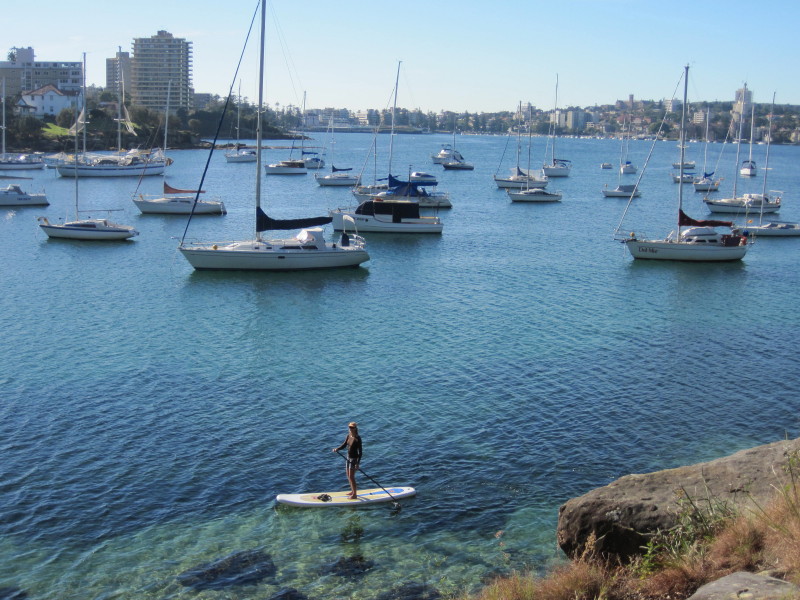
On Saturday, while stand-up paddleboarding in Sydney Harbour, I saw a sea lion, sunning itself on a marina right across the water from where I live. I’ve never seen one here, never even heard of them coming into the harbour and at first I thought it was a dog. 

I did a double-take and sure enough, there was the thick neck, the pointed nose, the lithe figure as it slinked into the water and was gone...Could it be an endangered Australian sea lion, usually found in south-western Australia? I paddled on, and glancing back saw that it had returned to its sun-spot between the boats. It just goes to show: you don’t have to live on Macquarie Island to have a sea lion in your backyard.

Sydney sea lion (thanks, Craig)
Then this morning, just as I was sitting down to work, I got a text message from my dad: “Whales out your window”. He lives up the hill from me, and we share a view of the harbour which, today, included a cluster of boats, including a tall ship and the Manly Ferry, loitering between North and South Head to ogle a couple of humpbacks at the entrance to Sydney Harbour on their way north from Antarctica to Queensland. 

The lovely Kaiser
My feline friend Kaiser died last year - I know, it's not very no-impact of me to have had a cat but in his defence, he wore two bells and in his twilight years was as mellow as a monk (i.e. not a hunter of native birds and mammals). I still miss his gentle soul, but lately I’ve been noticing how many wild animals we share this big city with:

Seagulls snoozing with their heads tucked under their downy wings on the beach. Pelicans soaring in formation high in the blue sky. Carpets of sulphur-crested cockatoos feeding on a cache of seeds. Stingrays on the sandy sea floor, below my surfboard. Sharks - I saw five (small ones) while swimming between Manly and Shelley Beach. A brush-tailed possum (below) that came aknocking one night last week, probably tempted by the little berry-like wreath that decorates our back door. 

And here's a brief clip of some dolphins we saw in North Harbour (shot by Craig, again from his paddleboard, last week). 

While we're on the subject of animate things, let's not forget the insect world. I had ants in my laptop a few weeks ago. Some vigorous drumming on the keyboard (when I wasn't even on deadline) shook them loose. And what about plants? And why not non-living natural things: rocks, the sea, the ground itself...

We need them all, to remind us what's important - that, whether we're aware of it or not, we are all part of the natural world, sea lions included.


Tuesday, 8 May 2012

The yellow brick garage-sale road

Last weekend I spent the sunniest part of a whole day in my own backyard - and it was one of the most enjoyable Saturdays I've spent in a while.

I met a whole bunch of friendly neighbours I'd never seen before. Talked about waves with a couple who bought one of my surfboards and a copy of my book Surf's Up: The Girl's Guide to Surfing (pardon the plug). Chatted with neighbours I do know, who popped in to say hello. Gave away brownies I'd baked the night before. Got rid of some pretty good stuff that other people wanted more than I do. Oh, and I made a few bucks in the process.

All thanks to the Garage Sale Trail - a Bondi-based initiative started in 2010 in the name of "sustainability, community and creativity" to encourage people to offload things that might otherwise go to landfill. That first year, there were 130 garage sales across Sydney. Last weekend, there were 6000 garage sales across Australia - pretty cool, huh? You can register your sale (and give it a name, like The Man Sale or Brownies in the Backyard) and people find you online or on their phones as they wander around your suburb.

I don't think I've ever spent a whole day in my own backyard. An afternoon, sure. A morning having breakfast and reading the paper in the sun, certainly. This was different. I liked the commitment of it. Stay. Go nowhere. Be here for whomever walks in through the gate. Greet them with a brownie (my favourite part).

There's something to be said for sticking with one thing, one place, particularly at a time when it's easy to feel paralysed by choice. Next weekend I might try staying somewhere else all day, switching off my phone and just being, well, there.

Psst! Want to buy a windsurfer? Two sails, harness, new mast-step, going cheap...


Thursday, 26 April 2012

River red gum time


“I speak for the trees, for the trees have no tongues…” The Lorax was too late to save the truffula trees in Dr Seuss's famous story (well, except for - spoiler alert! - that one lonely seed the Onceler gives the boy at the end, with the words, "Plant a new truffula. Treat it with care. Give it clean water. And feed it fresh air.") 

Beautiful, aren't they?
The river red gum forests of southern NSW looked like going the same way, having been logged since the 1820s - until July 2010, when the state government protected them in a 107,000-hectare swathe of national parks, nature reserves and regional parks. It was a good month for trees.

Last weekend I camped in one of these newly protected forests, Murrumbidgee Valley National Park. 

It was like going back to a freer, simpler time. My friends and I had to get a mud-map from the local tourist office to find our bush campsite, at the end of a muddy maze of dirt roads and on the banks of the Murrumbidgee River. There was no park entry fee, no camping fee. And when we got there, there was no one but us. 

Kayak on the Murrumbidgee
We spent two whole days in, on and next to the river, and always surrounded by red gums. On Saturday we kayaked for half a day, with a new tour operator called Riverina Experience, past fallen trees, high eroded banks and tangles of exposed roots, evidence of the floods a couple of weeks ago when two metres of rain fell in one drenching, 24-hour period. 

My, what big claws you have
From our kayaks, we saw FIVE koalas, in the high branches of the river red gums overhead. It's only the third time in my entire life (so far) I've seen koalas in the wild. Some of them were even active, climbing branches, looking down on us, listening to us with their teddy-like ears (does that count as anthropomorphising?). 

Bikes in the bush
On Sunday we rode mountain bikes, also with Riverina Experience, along the river and through Narrandera Common (officially called Narrandera Flora and Fauna Reserve), through open woodland. 

As our guide Ian Hardie explained, this is what the original, pre-logged red gum forests looked like: big, gnarled trees with spreading branches and lots of open space between them. (Our campsite, by contrast, had lots of skinny red gums close together, due to decades of management by forestry). 

Our river red gum campsite
We swam in the river. We camped by the river, listening to its gentle gurgle as we fell asleep in our tents (spacious Lansan Plus tents with massive vestibules, kindly supplied by – sponsor alert! – Kathmandu). We even met a Wiradjuri man, Michael Lyons, who showed us how he makes didgeridoos and boomerangs from local woods, offered us witchety grubs and took us to see an "Aboriginal hotel" - a hollowed-out red gum big enough for a family to sleep in. 

One of the most back-in-time aspects of the trip was our campfire. It was a real fire, made from gathered logs and sticks (not pre-chopped wood). Which (naturally) made me look into the environmental impacts of campfires. On the minus side: there's all that carbon dioxide going into the air, and faster than if the dead trees were left to decompose. 

On the plus side: it was one campfire used for three days, by seven people, for cooking, warmth and light (the days being cooler and shorter now) and we didn't have to throw away any butane canisters (from a fuel stove) after the trip. 

Wood is also more renewable than gas. Trees can be replanted; once gas (or any fossil fuel) is out of the ground, there's no giving the carbon back. Also, apparently fires that burn with intense heat and minimal smoke aren't so bad. I wouldn't want to have a campfire every night, but there was something wholesome about having one for this trip. (Read more about the environmental effects of burning wood here.)

Want to see river red gums? You can drive to Narrandera in under five hours from Sydney or Melbourne. Fly with Rex and you'll be there in an hour (we did the latter, and I offset my flights with Climate Friendly, as always).