Wednesday, 14 August 2013

A monkey at my table - week one in Ubud, Bali

A few days ago, a monkey ate my breakfast. I was sitting at a mosaic-topped table at Michi Retreat, just outside Ubud, looking across a small river valley at a hillside of terraced rice fields, when he swung down from the roof, island-hopped between tables and helped himself to my bowl of fruit salad and yoghurt. 

Michi monkey
While I ran to get Michi's chef, Iluk, hoping she’d have more success than I’d had at shooing him away (he just bared his two-inch canines at me), the monkey shook the flowers out of a nearby vase and raised it to his lips like a flagon of wine. 

I could have sworn he wiped the back of his hand across his lips (or is that my imagination talking?) before disappearing into the bushes below.

That’s life in Ubud - where nature is lush and on the loose - even when you're nowhere near the famous Monkey Forest. 

Michi Retreat, which I booked on Airbnb and where I’ve been for just over a week now, is about 10 minutes by scooter from Ubud’s hubbub, which is one of the things I like about it (its proximity and distance from Ubud).
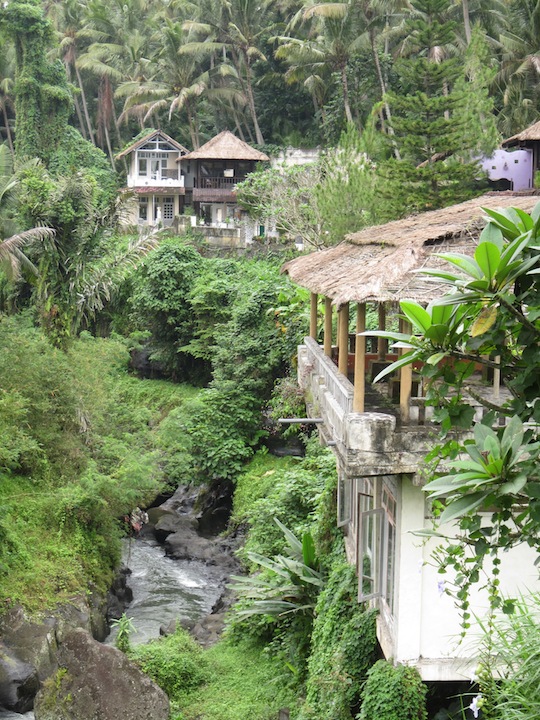
Michi Retreat
and the Wos River
It’s quiet - except for the sounds of the local village, Jukut Paku, in the morning and at night. Seems there's always something going on: chainsaws at dawn (cutting wood for carvings), the same Indonesian pop song played loudly over and over, weddings that go on for days. 

A few nights ago, the warm night air was alive with the haunting sounds of a "gamelatron” - a robotic gamelan orchestra in Michi's art gallery that had been left on after a blackout earlier in the day. I didn't mind; it reminded me where I am.

Michi deserves a blog post of its own (coming soon) but I will say this: it’s like nowhere else I’ve ever stayed. Built more than a decade ago as a retreat for artists, writers and other creatives, it’s a work of art itself, an endearing shambles of Buddhas and frogs and mermaids and themed rooms and collected things from around the world. 

Sea-replacement therapy
And it has a beautiful pool - if I can't be near the sea (Ubud is about two hours from Bali's south coast), I can at least swim every day.

My room, Hotaru (it means “firefly” in Japanese), is a little Japan of bamboo panels, shoji-screen walls and a balcony. 

I fall asleep with the overhead fan quietly whirring, wake up to the morning sun on the stone Buddha head on my balcony and, beyond, the rice paddies and palm trees. 

Buddha on my balcony
In the absence of a real home (is it really only two weeks since I moved out and dropped out of Sydney life?), I feel surprisingly at home here. 

The plan is to stay a month in or near Ubud, on a self-imposed writing retreat. Only I haven't done much writing so far.

California and Slovakia
on a Balinese beach
It's hard to resist the siren call of this steamy green and wholesome place. And there have been so many interesting people to talk to or to go into Ubud with for lunch or a yoga class, most of whom I've met at Michi. It's like an enormous, multi-national share-house that way.

There's Alfonso, the thoughtful Spanish surfer and IT guru who works here. Dominika the gentle soul from Slovakia who lives in London. Dipesh from Mumbai, now based in Singapore, who's into yoga and meditation. Kayleigh the fellow Piscean from California who came here for a 12-day detox.

Bali me
For all my travel-writing travels in recent years, I'd forgotten how easy it is to make friends when you're on the road, particularly in a place like Ubud, Bali's earthy, arty heart. It helps that I feel friendlier and happier too, on this break from big-city life. 

And I love that with barely any planning, you get to do fun things. Last Sunday, six of us piled into Michi's van for an all-day surf trip. After four hours of getting lost and checking various beaches, we ended up near Medewi, on Bali's south-west coast. As luck would have it, the beach we'd come to was in front of a posh resort, Puri Dujama.

Wandering in through the "staff only" gate, we made for the restaurant (where lunch cost us $10 each instead of $5 as in Ubud) then a few of us paddled out while the non-surfers relaxed by the pool.

The waves weren't great, but we had them to ourselves, and spent a heavenly, lazy afternoon in hammocks and walking on the black-sand beach. Before leaving, we watched the sun melt into a hazy horizon, folded ourselves back into the van and began the long drive back to Ubud, and home to Michi.

Wednesday, 31 July 2013

Moving out, not dropping out (well, maybe a little)

For the past few weeks, pieces of me have been breaking off and drifting away - not in an existential sense but physically (or at least metaphorically). My Life as I've known it for the past 10 years has been a Kon Tiki raft (great movie, by the way, about Thor Heyerdahl's voyage across the Pacific) made of logs that have been jostling apart.

To speak plainly, I've just moved out of the house I've inhabited and loved for 10 years. But it's taken a few weeks to peel off the band-aid of my attachment to it.

 Miffy the neighbour's cat
in my ex-home
The big stuff is easy - I've been selling or giving away furniture on Gumtree, meeting lovely people. Couples setting up house (and needing a couch), backpackers Stefano and Battiste heading up the coast (they took the roof racks), a woman who picked up a bookcase in her husband's Mustang convertible, surfer boys furnishing the verandah of their share house (with my barbecue and outdoor table and chairs). 

It's the small stuff that trips you up. I've always thought of myself as a minimalist - I don't often buy clothes, don't wear makeup, live fairly simply - but it turns out that even after culling a whole lot of stuff I still have enough of it to fill a small room (aka my storage unit).

Fridge magnets - kept
You realise how much you own when you have to eyeball each and every thing and decide its fate. 

How much do you love your favourite books, that stone Buddha that has been sitting ignored on your back patio for years, the fairy lights you bought in Cambodia, the smooth stones that remind you of a beach you’ve forgotten the name of?

I’ve been finding out these past few weeks. It's been a farewell to the old house and to old bits of me, like rewinding life’s videotape and watching the cherished bits again, sometimes in slo-mo (as I sit on the floor in the hallway at 10pm reading a page of the diary I kept when I was 13.)

It was all going swimmingly until I had to dismantle my desk. That was the point of no return. In my nomadic and uncertain life as a travel writer the desk I made out of a hardwood door (don't ask) 15 years ago has been my anchor, a still point I've always returned to. Now that's gone, I'm officially adrift - and it feels surprisingly okay. Sort of.

Then there was the mammoth task of packing everything into boxes, like doing 100 jigsaw puzzles at once, packing for upcoming trips and clearing out a house in which I'd inherited the left-behinds of past flatmates...

Now it's done, and on Monday this week I handed over the keys, closed the door for the last time (with no way of getting back in to the place that has felt like mine for so long) and said goodbye to my feline friend Miffy, a neighbour's cat who made herself at home at my place the last few months.

I've learned a few lessons big and small these past weeks:

Bay window with a much-loved view
  1. You can miss something before it's gone. I've been pre-missing the view from the house mostly, looking out at the harbour and boats and ferries more than usual, and making the most of favourite natural places (little beaches, low-tide rock-hopping routes, cockatoos in the Norfolk pines, the sunny backyard).
  2. It's liberating to not have a car, not think about petrol prices or parking - except when I want to go surfing (thank goodness for kind friends with cars). I got more exercise, walking and biking everywhere. And when I really did need a car, I booked the nearest GoGet one, called Gigi the Yaris (only $5.65 an hour + 40c per kilometre, petrol included, and there are more than 10 GoGet cars in my area).
  3. List something for free on Gumtree and it will go, guaranteed. People love a bargain, especially one that's free, and they're doing you a favour by coming to take away your old couches, beds, tables. On top of that, you get a surge of benevolence (at the giving part) and environmental points for diverting things from landfill for re-use. 
  4. You can donate foreign coins to UNICEF's Coins for Kids program - by taking them to any Commonwealth Bank branch (who knew?). Fifteen cents can immunise a child against polio, $6 can buy 500 water purification tablets (each one treating up to 5 litres of water), $20 can provide four mosquito nets to protect families from malaria. 
  5. Beyond Vinnies there are other ways to offload stuff that's still good enough to use. I gave Manly Food Co-op a bag of glass jars. Pot plants to friends. And a couple of surfboards to newbie surfers in developing countries, via
    Another me, Freshwater Beach
    Pic by Mark Watson
    LineUp surf shop in Dee Why, which runs surf trips to the Maldives, Sri Lanka, Samoa and Indonesia and often takes surfboards to give to kids there. I'll miss one of the boards, a bright green 6’3” I rode until I switched to a longboard after a surfing accident (on this very board) 10 years ago. But it's been out of the water pretty much since then, so hopefully it'll get wet again soon. 
Sorting through my stuff has been a kind of listening, as each thing tells me its story: how I came to have it, and why I kept it, and takes me on a little emotional trip. I'd forgotten about this aspect of moving, thought it would be all about simplifying, streamlining, getting back to basics. In fact it has been far from simple, and way more life-consuming than I'd thought, but no less interesting for that.

My next post will be from ... Ubud in Bali (wifi permitting) where I'm going for a month for some RnW (rest and writing). It'll be strange not returning to the old house, and there will be so many things I'll miss about it, but right now I feel ready to step off the ledge into the unknown.

On that note, I'll sign off with my favourite quote of the moment, by American author Edward Abbey:

"May all your paths be crooked, winding, lonesome, dangerous, leading to the most amazing view ...  where something strange and more beautiful and more full of wonder than your deepest dreams waits for you."

Friday, 28 June 2013

10 reasons to love Lord Howe Island

There's one question I'm always being asked, as a travel writer: "What's your favourite place in the world?". Which is, of course, impossible to answer. So I usually mumble something about having lots of favourites before remembering that there is one place I really love: Lord Howe Island.

World's most beautiful place?
It might sound parochial, picking somewhere in your own country when you've been to places like Mongolia and Madagascar, but this little island is a special place.

The first time I went to Lord Howe was for the 25th anniversary of its World Heritage listing six years ago. It was love at first sight. I was almost in tears flying in, seeing this mountainous tropical island appear out of the blue, so pristine, so natural.

Afterwards I fantasised about living there, vowed to return. And earlier this month, I did. For a week-long break from travelling and writing - which amused the owners of Pinetrees Lodge (where my lovely friend Emma and I stayed), who blogged that Lord Howe is where travel writers go on holiday.

Happiness is a Lord Howe holiday:
(with Em on our first day)
It was a week of peace and plenty in a natural place. I came back feeling as if I'd been away for a month. I felt healthier for breathing sea air, bushwalking and riding a bike (instead of a desk) every day and eating well (without having to cook!). And happier for the friendly vibe and for having time and space to relax, look at the trees, the sea, the tropicbirds.

Ah Lord Howe, let me count the ways I love thee:

1. Natural beauty - Lord Howe has it by the truckload: mountains (the twin peaks of Mt Gower and Lidgbird at the southern end, Mt Eliza at the northern end), a long, tropical-island lagoon encircled by the most southerly coral reef in the world, and wild surf beaches that'd fit right in on the NSW mid-north coast.

2. An island attitude - in a good way. Supplies come by sea every fortnight, supplemented by the catch of the day (usually kingfish), kids go to school barefoot (it's allowed under NSW law). You soon get used to waving at everyone as they walk, ride or drive by (there are a few cars on the island). After a day or two you can start to feel as if you've been living there all your life.

View from the dinghy
3. You can surf there - sometimes. The waves aren't reliable enough to put Lord Howe on the surf-trip map (thank goodness) but you can be lucky - as I was. The morning after I arrived Luke Hanson of Pinetrees kindly found me a wetsuit, borrowed a surfboard for me from his friend Bonky (true) and took me out to the edge of the reef in his aluminium dinghy. It was like surfing in Tahiti (I imagine): aquarium-blue water, those imposing mountains, long left-handers and only two of us out. I was as happy as a puppy for the rest of the day.

4. It's safe. Wherever you stay on the island, you won't have a room key. Nor will you get a lock when you pick up your rental bike from Wilson's Hire (only $32 for the whole week!). And when you want to go snorkelling at Ned's Beach, just drop a few coins in the honesty box; there is a price list, but it doesn't seem to have been updated since 1975, the rates are so low. At $3.50 an hour for a mask and snorkel, you're not renting it, you're borrowing it and leaving a tip!

Lord Howe's Norfolk Island pines
5. Pinetrees Lodge - the oldest lodge on the island, still family-run after 120-odd years (Luke and his wife Dani Rourke's daughters Elsie, 4, and Pixie, 2, are the seventh generation of the Rourke-Kirby dynasty). It has the best location - across the road from the middle of the lagoon beach, where its Boatshed is the perfect place for sunset drinks. Meals are included in the room rates - including afternoon tea (especially welcome in winter), a picnic or barbecue lunch delivered to your beach of choice when you're out exploring, and fine dining at night in the lodge's communal restaurant.


Sunset from Little Island,
beneath Mt Gower
6. The stars! Being 600 kilometres off the east coast of Australia, there's no light pollution, which makes for spectacular star-gazing. Em and I got into the habit of taking our after-dinner cups of tea over the road to Boatshed just to look up at the night sky, framed by the feathery tops of the Norfolk pine trees. The sunsets aren't bad either.

7. Birds. Hundreds of thousands of seabirds nest on Lord Howe and its satellite islands every year, including providence petrels. One afternoon we walked to the base of Mt Gower to call them down out of the sky. They'll land at your feet, apparently, or in your outstretched arms - but not for us. We did have a close encounter with an RAAF Hercules, however. Having seen it fly low around the island a few times, we joined a few locals on the breakwall at the end of the airstrip to watch this great, grey bird fly towards us over the ocean and right over our heads. So LOUD, so exciting!


8. It's off the grid. Seeing the Hercules was the high-tech highlight of our week. You can leave your phone, your mini iPad and your laptop at home when you come to Lord Howe; there's no mobile reception, no wifi. No TVs in the rooms at Pinetrees either. Long live printed newspapers: that's the only way you can know for sure the outside world still exists, thanks to daily Qantaslink deliveries. The perfect place to unplug.

9. You can go car-less. I loved exploring the island on my trusty rental bike, particularly the strip of road between the island's "main street" and the airstrip, a cathedral of green punctuated by fishing buoys tied to the trunks of palm trees (the locals' way of marking the secluded paths and driveways to their houses).

The view from the Mt Eliza track
10. It's an adventure playground. Unlike so many tropical islands, Lord Howe is rugged and wild. There are cliffs, canyons, offshore islands you could kayak too (on a calm day). I hiked up Mt Gower last time, a 10-hour epic you can do only with a local guide. This time I was content to take some shorter tracks that are no less spectacular. We hardly saw another soul.

I could go on, but you get the picture. As Emma put it, in her Lord Howe Love-in post: "If I could live there, I would, but failing that I will simply spend my days telling anyone with ears to go." Exactly.

Want to go? See the Lord Howe Island website and check out Pinetrees Lodge's winter deals and walking, wellness and wilderness weeks. I'll see you there.

Saturday, 22 June 2013

Camping in Cambodia

Who knew you could camp in the jungle in Cambodia? Or that Cambodia even had any jungle left, apart from those voracious Tomb-Raider vines and strangler figs that seem to be holding up various crumbling temples in Angkor Wat?

In fact, Koh Kong Conservation Corridor in Cambodia's south-west is a vast, lost world of rainforests, rivers and wild things. I spent a couple of days there earlier this year, including a night camping in the jungle, sleeping in a hammock beside a silent river, and it was one of the highlights of my whole Cambodia trip. It's all in my latest travel story, in this weekend's Sydney Morning Herald:

Boat approaching Tatai Falls,
Koh Kong, Cambodia
Somewhere, just over the rainbow
There's jungle in every direction. Bird calls I don't recognise. Monkeys watching us from boulders as we putter along the river in an open, bright-orange boat. 

It's just the start of our two-day stay in Koh Kong province and already I feel as if we've stumbled upon a Cambodia I never knew existed, one that pre-dates Phnom Penh, the Killing Fields, even Angkor Wat... Read the full story here.

I do love Cambodia, and it's so cheap to get there now I'm thinking about going again soon. Permit me a plug: Air Asia has return flights from Sydney to Phnom Penh (via Kuala Lumpur) from $448 including taxes. (Remember to keep the eco-theme going when you get back by offsetting your flights with Climate Friendly.) Happy jungle-travels!

Tuesday, 4 June 2013

Solitude, surfing and simplicity

You've probably had this conversation with friends before: if you were marooned on a desert island (and had time to pack), what would you take with you? What couldn’t you live without? How little would you really need?

My Dutch friend Simone Knaapen, whom I met in the surf when she was in Sydney a few years ago, found out first-hand what she could (and couldn't) get by without when she went to Great Barrier Island (Aotea) recently. 

“The Barrier”, as locals call it, is in New Zealand, just east of the outstretched, north-west pointing arm of the North Island - and forms a natural barrier between Hauraki Gulf and the open ocean.

Simone and the
catch of the day
Escaping winter in Holland, Simone flew to Auckland, rented a bicycle, a trailer and some camping gear, stocked up on a few provisions (the shops on the island are ridiculously expensive) and caught the ferry to the island. (You can also fly there.)

Her real destination, however, was a month of solitude, surfing and simplicity. 

Sounds like heaven to me, so I asked her about it (by email) on her return. 

What inspired you to go to Great Barrier? 
I heard about it from a Kiwi I met in Western Australia a few years ago and I’d been dreaming of doing a surf trip by bike since I started surfing five years ago. Because the island is only 47 kilometres long, it seemed like it wouldn’t be too far to ride between surf spots – although for a Dutch girl used to flat terrain it was a bit challenging cycling up the island’s hills, with camping gear and a surfboard! Also, I was curious about “off the grid” living. So staying on this tiny island for a month I hoped to get to know its people and way of life.

How would you describe the island, in five words? 
The purest way of living.

What was a typical day like for you?
I’d wake up with the warmth of the sun coming over the nearest hill, then I’d walk to the beach barefoot to check the waves, do some stretches or go for a swim. 

Living on “Barrier-time”, taking things hour by hour, not knowing what the day would bring, every day presented unexpected adventures: surfing, fishing, cycling, snorkelling for paua (abalone), hiking in Great Barrier Forest, or playing table tennis and chilling out with the locals.

At most of the campsites I was the only person camping. When night fell, especially around the new moon, it was so dark I couldn’t see my own hands if I stretched my arm in front of me. The sky was full of stars.

Washing day
What did you like most about being there?
Although I was by myself almost all the time I never felt alone. I was constantly surrounded by the sounds of the wind and birds and the amazing views of the hills, trees, beach and sea, even when I was doing simple things like making porridge or washing clothes. And I think I experienced all this so intensely because I was alone - four weeks with a total lack of brick, concrete, billboards, fashion, mobile phones, traffic lights and only a handful cars not driving faster than 45 kph. 

Simple living
Also the attitude of most people I met impressed me, their commitment to a simple way of living. Which I think isn’t so easy. To make ends meet financially, to catch your own dinner every night and to be truly dependent on your home-grown veggies requires a lot of hard work and determination. Only 800 people live on the island so everybody waves to each other, stops to chat and is very welcoming – people would invite me over for a cup of coffee and I stayed with some people I met in their tiny hut which has no electricity. 

Did you miss anything about civilisation?
One outcome of this "back to basics" trip that I never expected is a greater appreciation of my daily life back in the Netherlands. For the past few years I’ve been complaining about how noisy, busy and cramped Amsterdam can be. 

But on this trip I realised I’m really happy to live in a place with such a great diversity of people with different cultural backgrounds, different outlooks on life. It’s also the only place where all my friends and family live, and where I can go to a gay bar on Friday night and be at the beach surfing on Saturday morning within a 40-minute drive.

The "Into the Wild" bus
Has your life changed since the trip?
My stay at the Barrier really helped me focus on living a simpler life in Amsterdam and cutting out things I don’t like anyway like commercial entertainment and buying clothes. I’ve started my own veggie garden and have decided to only buy second-hand things on ebay (from individuals) and from local shops, and no new clothes for the next year. It feels great, I believe I'm helping the environment and it saves a lot of time and money too. On Great Barrier I was happy not having to go to the supermarket. In Amsterdam I’ve deleted the supermarket from my world too (well, almost)!

What advice would you give others wanting to do something like this?
My only travel advice is to take it slowly. Lose the goal of trying to see everything. For me travelling is not about “seeing” so much as about getting in touch with the place and its atmosphere, with the locals and their way of living. You can only get to know and feel that when you hang around for a while.

[Simone's now happily back in Amsterdam looking forward to a European summer. Meanwhile, I'm dreaming of escaping the Sydney winter...]