Monday, 24 October 2011

Mustang moments

I’m in limbo. Just returned from a trek in a remote region of Nepal called Mustang, once the Kingdom of Mustang (there is still a king, whom we met for tea one afternoon). And I'm about to go away again. So I'm in-between and out of sorts. Coming AND going. Washing and re-packing. Longing and looking forward, and trying to be here too – by surfing, swimming in the sea, pegging clothes on the line...Still, I miss the simplicity of being “away” too.

This two-week World Expeditions trek was one of those stripped-down, pared-back experiences I so love. Upper Mustang, where we were, has only been open to trekkers since 1992 and access is still restricted (our permits cost $US500pp for 10 days), partly because of its proximity to Tibet. Tibetans fled across the border into Mustang after the 1959 Chinese invasion, the pro-Tibet resistance movement based itself here for many years and it's still more Tibetan than Nepali.

That’s one layer of the place. Another is its incredible landscapes. Wind-carved ranges, snow-capped peaks and valleys where tiny villages nestle. 

Only about 5000 people live in Upper Mustang and everything man-made comes from the earth anyway: mud-brick houses, thick wooden doors, monasteries painted with clay, stone walls against the fierce winds.

Mules carried our kit-bags and we had a crew of Nepali cooks and sherpas. So all we had to do was walk (with daypacks) - up and down and up again (it is Nepal after all), climbing to 4000-metre passes, descending to rivers, stopping to look inside dark, incense-choked monasteries.

I like the fact that, on trips like this, you're just in one place, with a relatively small group of people to interact with. You do one thing at a time, take one step at a time. My only distraction was a copy of Wuthering Heights (!) that I read by the light of my head-torch at bedtime.
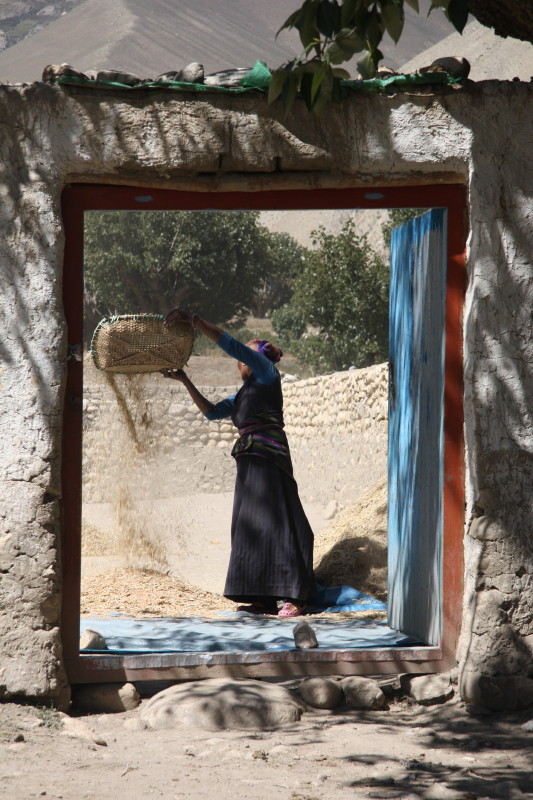
My mind calmed down, my body became stronger. After a few days, I even stopped looking forward to reaching the next pass or the next village, started just enjoying the walking, tough though some of it was. 

And every time I lifted my eyes, there was an open, earthy spectacle. It was like being at sea, only with more dust.

One day I stopped to pee (with a view!); my fellow trekkers went on ahead and out of sight, others behind me had not yet caught up. I looked around. There were no villages. No prayer flags or chortens. I was absolutely alone, in spacious solitude. 

Back in the big city now, I'm wary of romanticising Mustang; for those who live there, life is desperately hard. Most people spend winters in Kathmandu or Pokhara; it's just too bleak and cold to stay. But for those of us privileged to come, and go, it's one of those places that takes you out of your world and into another. 

So I pore over my photos and show them to friends. See, I want to say, this is what I mean...Until I can go away and be simple all over again...

Saturday, 17 September 2011

Can camping be no-impact?

Dolphins, dingoes and downpours. That’s how last week's camping trip started. But by Friday evening (we arrived Thursday) the skies had cleared and we surfed until sunset with a pod of dolphins.

Somewhere on the Australian coast
It was a much-needed time-out, four days off for no impact girl (and boy) at a spot on the NSW coast that shall remain nameless here because, well, it’s a favourite of mine. 

It never seems to change, has uncrowded waves and you can pitch your tent so close to the beach you can see the surf from your sleeping bag.

I love the simplicity of camping and surfing, how well they go together. They’re both minimalist at heart, involve connecting to the elements and slow life down from a rush to an amble. 

The only writing I did while away
It was great to go to bed early and wake up before sunrise. To see dingoes trotting through the campground and ospreys and eagles overhead. To time our surf sessions with the tides and swell, not our own schedules. To watch the moon rise and travel halfway across the sky while we cooked and ate our dinner. 

One night, toasting marshmallows over the campfire (surely one of the est things about camping), we got to talking about the eco-impact of camping. 

On the plus side: We weren’t using any electricity (except in the toilet block – and we could have used our head torches just as easily). There was no mobile reception, let alone wifi for the laptops we didn't have. We didn’t even wear watches. We used a Trangia stove that runs on methylated spirits, a renewable resource (it’s made from sugar cane). We didn’t have a generator or use any refrigeration (just an esky filled with ice-bricks from our freezer at home). We didn’t buy newspapers or even go into any shops – which were 20 minutes away by car. 

Hammock time
We used less water and fewer detergents than usual (we rinsed off under a cold outdoor shower after surfing, washed our dishes in cold water). Everything we did was essentially low-impact: surfing, walking, reading in hammocks, playing chess, yoga. One day we found plastic bottles, thongs and pieces of polystyrene amongst the driftwood on a beach, and spent a cheerful hour picking up as much as we could, filling two large sacks with rubbish.

Shells collected (and returned later)
There were impacts, of course. We had to drive to get there: 900km including side-trips on the way there and back (though I offset my car’s emissions with Greenfleet). We had a campfire every night which, of course, releases carbon dioxide into the air. We couldn’t compost food scraps as we do at home. The only recycling facilities available took glass and plastic but not paper or cardboard (we did bring some recycling home with us). We bought more food with packaging than usual, for convenience and because we couldn’t keep food as long without refrigeration (though we did use reusable clip-seal bags). 

As well as the Trangia stove, we had a gas stove that runs on non-recyclable butane cylinders. And we had to buy a 10L plastic container to BYO drinking water (a giant plastic water bottle!) – though on our last day we found we could boil water from the rainwater tank at the toilet block.

Natural beauty
See what having a no-impact project does to you? You see everything through a no-impact lens, think about things a bit too much, but hopefully become more conscious for it.

I’d like to do a real no-impact camping trip sometime, but until then I've decided the benefits of camping outweigh the (small) eco-costs, by reminding us to live with less stuff and more nature-time.

Do you have any low-impact camping tips?

Monday, 29 August 2011

Every day is Dolphin Day

It’s shocking, compelling, distressing, inspiring. I watched The Cove again last night, an impassioned plea to stop dolphins being killed in Japan, and had to write something here, if only to urge those of you who haven’t seen this film to see it. 

It’s part doco, part adventure story about a group of American activists, film makers and free divers, led by reformed and repentant dolphin trainer Ric O’Barry (who trained Flipper for the 1960s TV series), on a stealth mission to capture footage of an annual dolphin slaughter in a secluded cove in Japan.

Having studied zoology, I don’t go in for anthropomorphising animals, but I've also surfed with dolphins on the Australian coast, swum with 300 dolphins in New Zealand and watched them from boats all over the world, and find it hard not to feel a connection with them, and all cetaceans. Besides, O’Barry’s arguments against keeping dolphins in captivity are compelling. In the wild, they can travel 60 kilometres a day, he says. They’re also acoustic creatures – when we’re in the water with them, they can see right through us, see our hearts beating. Their sensitivity to sound makes confinement especially stressful.

O’Barry is making amends for his complicity in training dolphins, by being an activist and bringing to the world's attention what is happening in this cove. 

This is what is happening: up to a dozen fishing boats go offshore from Taiji (in south-east Japan, south of Tokyo) and bang on the ends of long metal poles they put into the water, herding passing dolphins into a nearby bay and trapping them behind nets. Dolphin trainers come here from all over the world to choose wild dolphins for their sea worlds and marine parks, paying up to $US300,000 per animal. The film says Taiji is the world’s largest supplier of dolphins to marine parks.

(As an aside: apparently many dolphinariums protested at the film’s portrayal of their role in the Taiji hunt and in the US it has been illegal since 1993 to import dolphins caught through drives such as the one at Taiji, but the fact remains that marine parks are keeping dolphins in captivity for the amusement of our species.)

The remaining dolphins are herded into a cove, out of sight of the road and any onlookers, where they are speared, knifed and harpooned by men in open boats. All the dolphins are killed, and the meat sold all over Japan. “It’s the largest slaughter of dolphins on the planet,” says O’Barry.

About 23,000 dolphins are killed at Taiji between September and March every year. It's about to start again, on 1 September. What can we do? 
  • Watch The Cove (it's on DVD). Directed by National Geographic photographer Louie Psihoyos it has won more than 20 awards including the Academy Award for Best Documentary Feature in 2010. The film doesn’t demonise Japanese people and in fact a Japanese activist group called People Concerned for the Ocean distributed free DVD copies of the film to Taiji’s 3500 residents in March this year.
  • Visit Takepart.com/thecove for ideas on what to do
  • Find out more at SaveJapanDolphins, which has a comprehensive FAQ about Taiji
  • Sign a petition to help stop the dolphin slaughter
  • Don’t go to dolphin shows at zoos; if demand dries up, zoos will stop keeping dolphins.
  • Join Surfers for Cetaceans
  • Using your iPad or smartphone, recreate the scene from The Cove where Ric wears a screen showing footage of the Taiji dolphin hunt at an International Whaling Commission meeting. See this link for images and video. 
  • Celebrate Japan Dolphins Day on 1 September, and remember that every day is dolphin day. May they swim in peace...


Tuesday, 23 August 2011

Nature + night


Last night I did something I’ve never done before: I joined a bunch of women to go trek-training at Balmoral (Sydney). It was a mild winter’s night, you could see stars between the clouds and we spent two hours beach-walking, hill-climbing and bushwalking in the dark, with head torches, led by the fearless and super-friendly Di Westaway, who runs Wild Women on Top training sessions for female trekkers. Di also has a new book, How to Prepare for World Class Treks, which has all sorts of tips and wisdom specifically for women, on how to train for and tackle treks all over the world.

Everyone was there last night for different reasons; I’m training for a trek in Nepal next month, some are preparing to climb Kilimanjaro or Aconcagua, others are doing the gruelling 48-hour Oxfam Trailwalker next weekend - which, incidentally, has a host of "tread lightly" guidelines for the 100km Hawkesbury to Sydney Harbour trek. (I love learning about events like this.) 

It was beautiful to be outside at night – walking past warmly lit houses, and not missing being inside at all. There was chatting and laughing. It felt like a little adventure in the big city. 


Of course it was too dark for photos so I’ll include a couple from a daytime bush walk I did last weekend. The wildflowers are out, and some other flowers too (jasmine is surely the scent of spring).

There's a lot of talk about saving energy, but it feels great to expend some (non-harming) human energy now and then, at night, in a natural place. It's the way of the no-impact warrior (princess).

Tuesday, 16 August 2011

Let there be candle light

It’s winter, it’s getting dark early and that’s a good excuse to burn candles – beeswax* of course, and made by Northern Light. Love my new Northern Light beeswax candles. I ordered them online, and a couple of days later a little box of goodness arrived on my doorstep. It’s incredible the lengths these people go to, to be sustainable. The packaging is all post-consumer waste paper, printed with soy-based inks, the boxes are designed to be folded so there’s no need for toxic glue, and they’re sealed with paper tape.

Inside, I found a little hand-written note (on recycled paper of course) welcoming me as a new customer, and a very welcome gift: a “Calmer Light” poured and packed by Carmelite nuns with a message on the bottom that you can only read when the candle has been burning long enough to make the wax transparent: “Do justly, love mercy, walk humbly”. See what I mean? The candles themselves exude a sweet, honey scent and a golden glow. 

Northern Light’s commitment to sustainable manufacture is impressive, to say the least. For instance: the wax is melted using a heater that runs on macadamia nut shells instead of electricity, rainwater is used instead of chlorinated town water and the studio (it can hardly be called a “factory” situated as it is in the lush hinterland of northern NSW) is designed to maximise natural light, wind and rainwater for heating and cooling. 

The wax-melting room even has a glass roof, to reduce the power required to keep the wax molten (it can get up to 50ÂșC in there in summer), thereby cutting carbon emissions. Naturally, all their candles are made using organically certified, Australian beeswax – “the cleanest, purest beeswax you can buy” – and cotton wicks.

The man behind all this sustainable candle-making is Jeffrey Gibbs, who has been involved in beekeeping for over 30 years. I called Jeffrey this afternoon with a few practical questions – like: what can you do with leftover beeswax, and are the tin wick-stands recyclable? – which he was happy to answer (see below, and yes) before the conversation veered onto more esoteric subjects. “There’s nothing better in the world than living with peace in your heart and doing something you love,” he said at one point. It was a breath of fresh, Byron Bay air in my Sydney afternoon.

Northern Light made the world’s first beeswax tealights, in 1992, and were also the first to put tealights into reusable, recycled Australian tin cups, instead of the throwaway aluminium cups that come with most tealights. Now they're the world’s largest producer of beeswax candles, making 650-700,000 tealights a year, with just seven staff. 

Their candles have lit up post-tsunami Japan, Ferrari family functions in Italy, Rae’s on Watego’s (a luxury lodge at Byron Bay), even the Vatican; 25,000 Northern Light candles illuminated the Pope’s World Youth Day event in Sydney in 2008.

Here are 7 more beeswax-related things I learned today:
1. Before World War I, bumble bees were called “humble bees”; even Charles Darwin called them that in The Origin of Species, in 1859.

2. Australian native bees don’t produce much wax, traditionally used to make the mouthpieces of didgeridoos in northern Australia. Northern Light’s bees are Italian.

3. The average worker bee has a lifespan of 4-5 weeks. 

4. Beeswax is the cap that seals the honeycomb chamber in which bees put their honey. Sealed like this, honey can last for 1000 years.

5. Candle-makers were once called "chandlers". 

6. Tealight wicks have 24-strand wicks; large cathedral candles have 96-strand wicks (and you thought thread-counts were just for bed linen).

7. Leftover beeswax can be melted, strained through a cloth bag and scented with tea tree oil to make a waterproof shoe polish. Who knew?

Thank you, Northern Light, and thank you, bees.

*Beeswax candles, for the uninitiated, are the only non-polluting, good-for-you-and-the-environment candle. They’re better than paraffin candles (which emit, cough splutter, toxic fumes because they’re made from petroleum), better than palm oil candles (which are causing deforestation on a massive scale in places like Indonesia and Borneo, the last bastions of the endangered orangutan and Sumatran tiger) and better than soy candles (the soy is often genetically modified and has to be converted into a wax which is energy intensive and involves adding all sorts of nasties).